.jpg)
|
| |
|
|
| |
|
The idea of artificial intelligence (AI) as we understand it now, can be traced back to a prominent 20th century British mathematician and computer pioneer, Alan Mathison Turing. Since the 1930s, Turing was taken up by what machines could do by 'themselves' outside rote arithmetic.
|
|
Although Turing never spoke explicitly about "social good," his work reflected a belief that computation could extend human intelligence and address consequential problems. His early ideas demonstrated a foundational principle that would later define artificial intelligence: that machines can assist human reasoning at scale to tackle complex, real-world challenges.
|
|
As a formal, global movement, 'AI for Social Good' emerged much later, between 2016 and 2019, as advances in machine learning, expanding data ecosystems, and cloud computing made scalable AI systems deployable. This time span coincided with when the UN's Sustainable Development Goals were sharpening international focus on measurable social outcomes.
|
|
As AI tools began enabling large-scale data analysis and predictive decision-making, governments and development institutions recognized their potential to accelerate progress across sectors including in health, agriculture, climate resilience, and financial inclusion. Since then, global policy discussions have increasingly focused on aligning AI with public outcomes to help ensure its benefits are more equitably distributed.
|
|
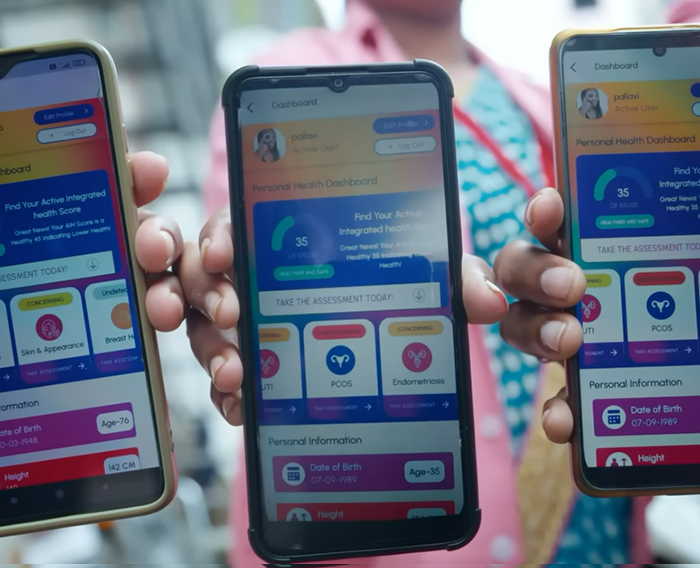
By convening the recently concluded India AI Impact Summit in New Delhi from February 16–20, 2026, India has made its stance clear: it views AI not merely as a driver of economic growth, but as public infrastructure designed to strengthen institutions, expand inclusion, and accelerate social progress through responsible and sovereign deployment.
|
|
Mandating AI for All

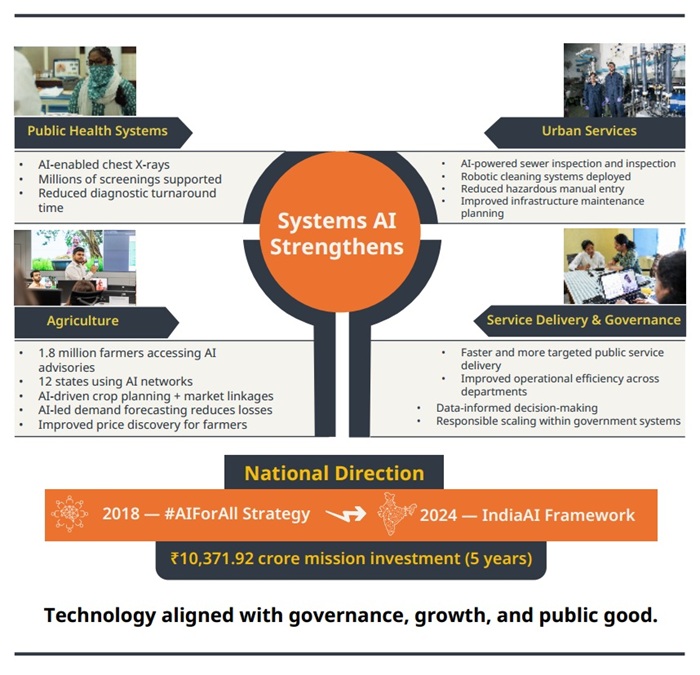
This direction has been years in the making. What began with NITI Aayog's 2018 National Strategy for Artificial Intelligence, that laid out a comprehensive
AIForAll strategy
moved into mission mode in 2024 under the IndiaAI framework, with a cabinet-approved
₹10,371.92-crore
investment over five years. Anchored in shared compute, trusted public datasets, startup support, skilling, and embedded governance, IndiaAI clearly positions artificial intelligence as national digital infrastructure rather than just a tool for innovation.
This reflects a recognition of both the technology's potential impact and promise. Industry and policy analyses suggest for example that sustained AI adoption could contribute a staggering
$1.7 trillion
to India's economy by 2035, depending on the pace and breadth of deployment. These projections also point to significant potential for productivity gains across health, agriculture, public services and urban systems, alongside substantial shifts in how work is performed.
Let us take a closer look at how policies that facilitate the adoption and appropriate use of AI and new-age AI startups are having an impact across sectors including in health, nutrition and sanitation.
|
|
Improving Timely Diagnoses
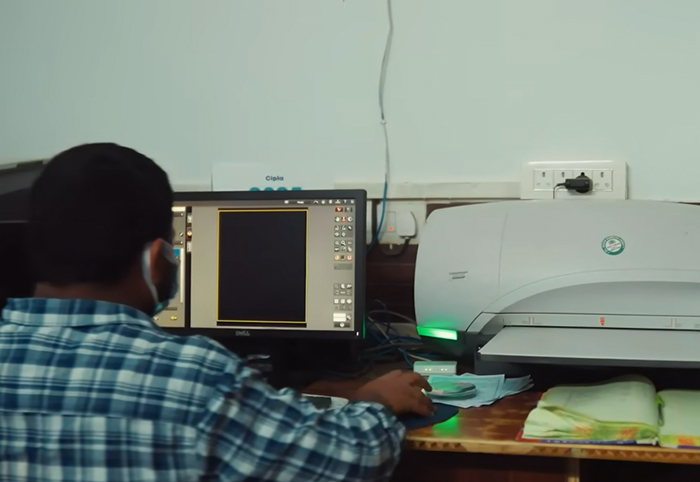
In public health, AI is being deployed to strengthen existing government programs. Under India's National TB Elimination Program for example, multiple states have integrated AI-enabled chest X-ray interpretation into routine screening workflows at district hospitals, medical colleges, and mobile diagnostic vans, in line with WHO guidance on TB triage.
This is often done through partnerships with organizations working at the grassroots. One such health-tech firm is Mumbai-based firm Qure.ai. Established in 2016, it uses AI tools to analyze digital X-rays in minutes to flag probable TB cases, supporting faster triage in high-burden districts where radiologists are hard to find. Complementing such efforts, Mumbai-based non-profit Wadhwani AI works directly with government health departments to deploy AI models that help identify patients at risk of treatment default and support frontline workers with targeted follow-ups, strengthening continuity of care within the public system.
Peer-reviewed evaluations, WHO guidance, and program disclosures from India's public health ecosystem indicate that AI-assisted chest X-ray screening has been deployed across several states, supporting millions of screenings and significantly reducing diagnostic turnaround times in TB care pathways. These efforts demonstrate how AI-driven diagnostic support can enhance early detection and clinical triage across public health programs, extending well beyond TB to strengthen population-level health outcomes.
|
| |

|
Protecting Smallholder Farmers
In agricultural development, AI is increasingly being used to reduce uncertainty for smallholder farmers, who account for over
85%
of India's agricultural holdings. Tech-enabled platforms such as DeHaat operate through a hybrid model, combining AI-driven insights with a strong on-ground advisory network. While the platform uses AI to generate crop-specific advisories, weather-linked guidance, and input planning recommendations based on soil data, satellite imagery, and local climate conditions, it delivers these insights directly to farmers through physical centers, trained local advisors, and Farmer Producer Organizations (FPOs) embedded in farming communities.
According to its reports, DeHaat reaches over 1.8 million farmers across 12 agrarian states, including Bihar, Uttar Pradesh, and Odisha. By pairing digital intelligence with in-person advice, along with better access to quality inputs and market linkages, the platform helps farmers reduce input waste, improve crop planning and achieve greater income predictability. These outcomes also align closely with government priorities to use AI to strengthen resilience and livelihoods across India's smallholder-dominated agricultural economy.
Complementing such models, Bengaluru-based Ninjacart uses AI-driven demand forecasting and supply-chain optimization to connect farmers directly with retailers and institutional buyers across India. This helps to both reduce post-harvest losses for farmers and improve their price realization. When viewed together, these innovations illustrate how AI has the potential to meaningfully transform farming from a high-risk livelihood into a more efficient, productive and climate-resilient enterprise.
|
| |
|
Extending Dignity to Sanitation Workers
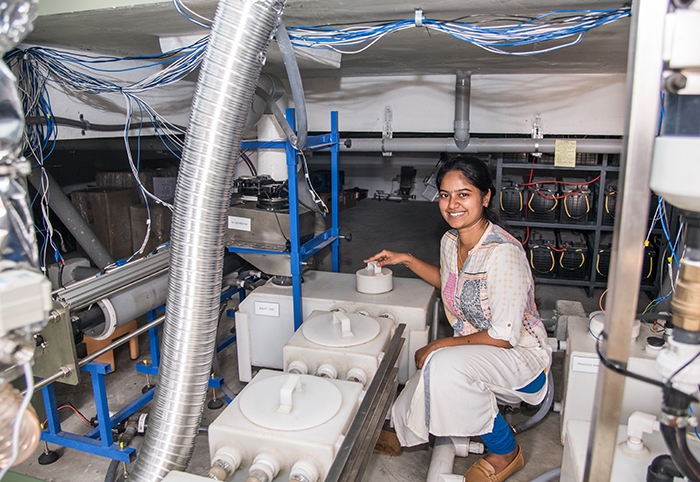
AI and robotics are also helping address long-standing occupational risks. India's sanitation workforce continues to face dangerous working conditions despite legal prohibitions on manual scavenging. In response, AI-enabled robotic systems are now being deployed to mechanize sewer cleaning, reducing direct human exposure to hazardous environments.
One such innovation is Bandicoot, developed by Kerala-based Genrobotics. Equipped with robotic arms, high-resolution cameras, gas sensors, and AI-assisted navigation, the robot enters sewer manholes to remove sludge and solid waste while operators control the system safely from above ground. Today, Bandicoot has been deployed in multiple Indian states through municipal bodies and public sector agencies, supporting safer sanitation practices while advancing the goal of eliminating hazardous manual sewer cleaning.
Together, these examples from health, agriculture, and sanitation show how AI is increasingly being embedded into public systems to solve real-world challenges. By combining technological innovation with strong policy support, India is building an ecosystem where AI not only drives economic growth but also strengthens public service delivery, improves livelihoods, and promotes more inclusive and sustainable development.
|
| |
The Aksha Dialogues monthly newsletter brings forth relevant health and development themes and highlights insights, innovative solutions, and human impact stories. Subscribe to Aksha Dialogues to stay connected with our events and updates, and learn more about how you can join the conversation on building a better tomorrow. SubscribeThe Aksha Dialogues newsletter sheds light on India’s challenges in healthcare and social development and provides access to events and updates from Aksha. Join Aksha Dialogues to stay informed about the outcomes of India’s key development challenges and successes and be part of the conversation. Subscribe |


