|
|
|
Strengthening Child Survival Through Immunization
|
|
How India’s immunization systems are evolving to deliver coverage, continuity, and care
|
|
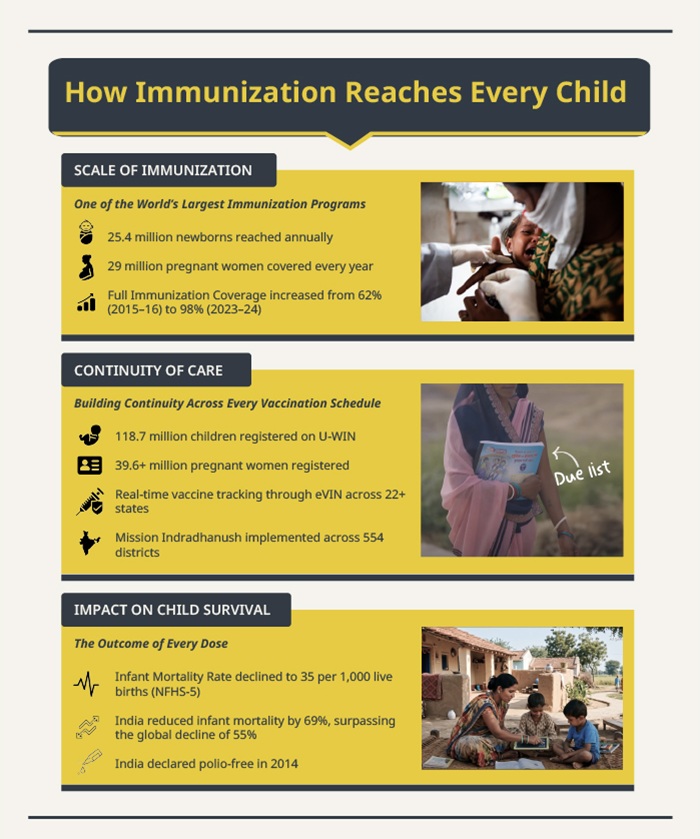
India’s immunization story does not begin with the access to vaccines. It begins with a conviction, deepened over decades, that every child regardless of where or to whom they are born—deserves an equal chance of surviving. Central to this mission has been the urgent objective of reducing infant and child mortality. According to NFHS-5 (2019–21), India’s infant mortality rate declined to 35 deaths per 1,000 live births, reflecting continued progress in maternal and child health outcomes over the past decade.
|
|
Sustaining this progress has required close collaboration between the government, private healthcare providers, technology partners, and frontline workers operating across every link in the immunization value chain.
|
|
This work has been decades in the making. The country’s approach to immunization began to take institutional shape in the late 1970s, when the country expanded access to childhood vaccines through a structured national program, later formalized as the Universal Immunization Program (UIP), aimed at protecting children from vaccine-preventable diseases and reducing child mortality. What followed was a sustained effort to strengthen delivery systems and expand reach across diverse settings. The program currently reaches 25.4 million newborns and 29 million pregnant women annually, making it one of the world’s largest such programs.
|
|
Over time, expanded delivery systems and outreach have contributed to a decline in under-five mortality and a steady rise in Full Immunization Coverage: up from 62 percent in 2015–16 to over 98 percent in January 2026. Under India’s National Immunization Schedule, children are provided protection against multiple vaccine-preventable diseases across different stages of early childhood. Pregnant women too receive immunization support aimed at reducing maternal and neonatal risks.
|
|
The full value of this schedule, however, is only realized when every dose is delivered on time. World Immunization Week, commemorated globally from 24–30 April exists to reinforce that simple idea: protection requires recall and regularity over time. For a country as populous and diverse as India, this is especially relevant. A child may receive the first dose of a vaccine but miss all subsequent ones and end up falling sick with vaccine-preventable diseases. This is why sustained coverage and not just initial access is what determines whether immunization truly protects a generation. India’s progress on this front is measurable: the Gates Foundation’s 2025 Goalkeepers Report notes that introduction of vaccines such as pentavalent and rotavirus has helped reduce child deaths from pneumonia and diarrhea by more than half over the past two decades.
|
|
|

|
Ensuring Continuity Across Every Vaccination Schedule

|
|
Delivering vaccines consistently across geographies and population groups demands systems that can respond with agility to mobility, varied service points, and diverse living conditions — particularly in urban areas with high rates of private-facility births, and among migrant populations.
|
|
Over the past decade, India has strengthened the efficiency of its delivery architecture to meet this challenge. The Electronic Vaccine Intelligence Network (eVIN), developed under the National Health Mission, digitizes vaccine stock management and cold-chain temperature monitoring from national stores down to sub-district levels. This enables a rapid response to stock-outs or equipment failures before they disrupt immunization sessions. Rolled out across more than 22 states in two phases, eVIN is complemented by IoT-enabled tracking and portable cold-chain solutions for off-grid settings.
|
|
Parallel to these efforts, innovations on the ground are also strengthening the final leg of delivery. Domestic hardware is, for example, addressing vulnerabilities posed in the final transit phase. Blackfrog's Emvólio, a battery-powered refrigeration unit, maintaining pre-set temperatures for up to 12 to 20 hours, has been deployed in close partnership with the government and global health partners. It supports the delivery of over 200,000 doses across 16 states while enabling end-to-end traceability aligned with the Ayushman Bharat Digital Mission.
|

|
From Supply to Continuity of Care
|
|
But reaching a child once is not the same as protecting them through a complete schedule — and for children who move, that distinction is where the system has historically lost track. Paper-based vaccination records don't for example travel with children who move districts, are born in private facilities, or live in transient conditions. This leaves gaps that supply-side systems alone cannot close. U-WIN, India's national digital immunization registry launched in 2024, solves this by creating a beneficiary record from birth that follows the child wherever they go. Offline data entry, automated reminders, and QR-based certificates ensure continuity of the vaccination schedule regardless of geography or facility type. With 118.7 million children and 39.6+ million pregnant women already registered on the platform as of early 2026, its integration with private facilities is extending continuity of care beyond the public system — capturing births and ensuring the first doses reach children regardless of where they are born.
|
|
The country’s immunization program has delivered several landmark milestones: polio-free certification in 2014 and the national rollout of rotavirus vaccines in 2019, that target a disease responsible for an estimated 78,000 child deaths and nearly 900,000 hospitalizations annually in India. Expanded pneumococcal coverage has reduced pneumonia mortality.
|
|
These milestones are reinforced by Mission Indradhanush, India's flagship drive to identify and vaccinate zero-dose and partially immunized children. Completed across six phases in 554 districts, its first two phases delivered a 6.7 percentage point rise in Full Immunization Coverage within a year. The fifth phase — Intensified Mission Indradhanush, launched in 2017 with sharper urban focus and inter-ministerial coordination — recorded an 18.5 percentage point gain over the NFHS-4 baseline across 190 districts.
|

|
Bringing Vaccines to Every Community
|
|
Across tribal areas, dense urban pockets, and remote rural settings, frontline workers and program managers adapt delivery strategies to the conditions on the ground — targeting low-performing sub-centers, designing context-specific outreach, and ensuring children missed in routine sessions are reached through dedicated drives. Demand generation and community mobilization under Mission Indradhanush alongside its targeted drives in chronically underserved areas have been central to sustaining and extending coverage.
|
|
At the center of these concerted efforts are frontline workers — ASHAs, Auxiliary Nurse Midwives (ANMs), and Anganwadi workers whose role extends far beyond vaccine delivery. India deploys over 10 lakh ASHAs alongside approximately 13.96 lakh Anganwadi workers, forming one of the world's largest community health workforces. ASHAs mobilize families for immunization and antenatal care, counsel on the importance of vaccination, and conduct home visits. ANMs run immunization sessions, maintain health records, and supervise ASHAs in the field. Anganwadi workers, embedded in the same communities, support this effort by identifying eligible children and pregnant women. Together, they serve as the bridge between what the program promises on paper and what a child receives.
|

|
Carrying the Promise Forward
|
|
India's immunization journey demonstrates how a large public program can evolve without losing sight of its founding purpose. The promise that began as a national commitment — that a child's chance of survival should not depend on the circumstances of their birth has been built into a public effort that continues to grow and adapt.
|
|
Sustaining that momentum has never been more important. India's immunization trajectory reflects what sustained political commitment, frontline infrastructure, and multi-sectoral collaboration can achieve at scale. Coverage has expanded, equity gaps have narrowed, and the program continues to adapt — reaching harder populations, introducing new vaccines, and building the digital backbone to track every child. What the evidence from India demonstrates, above all, is that immunization is not a one-time intervention but a system — one that requires ongoing investment, institutional continuity, and community trust to sustain progress and ensure more children survive and thrive in the years ahead.
|
|


